Automate document extraction using AI with Zapier
के साथ शुरू
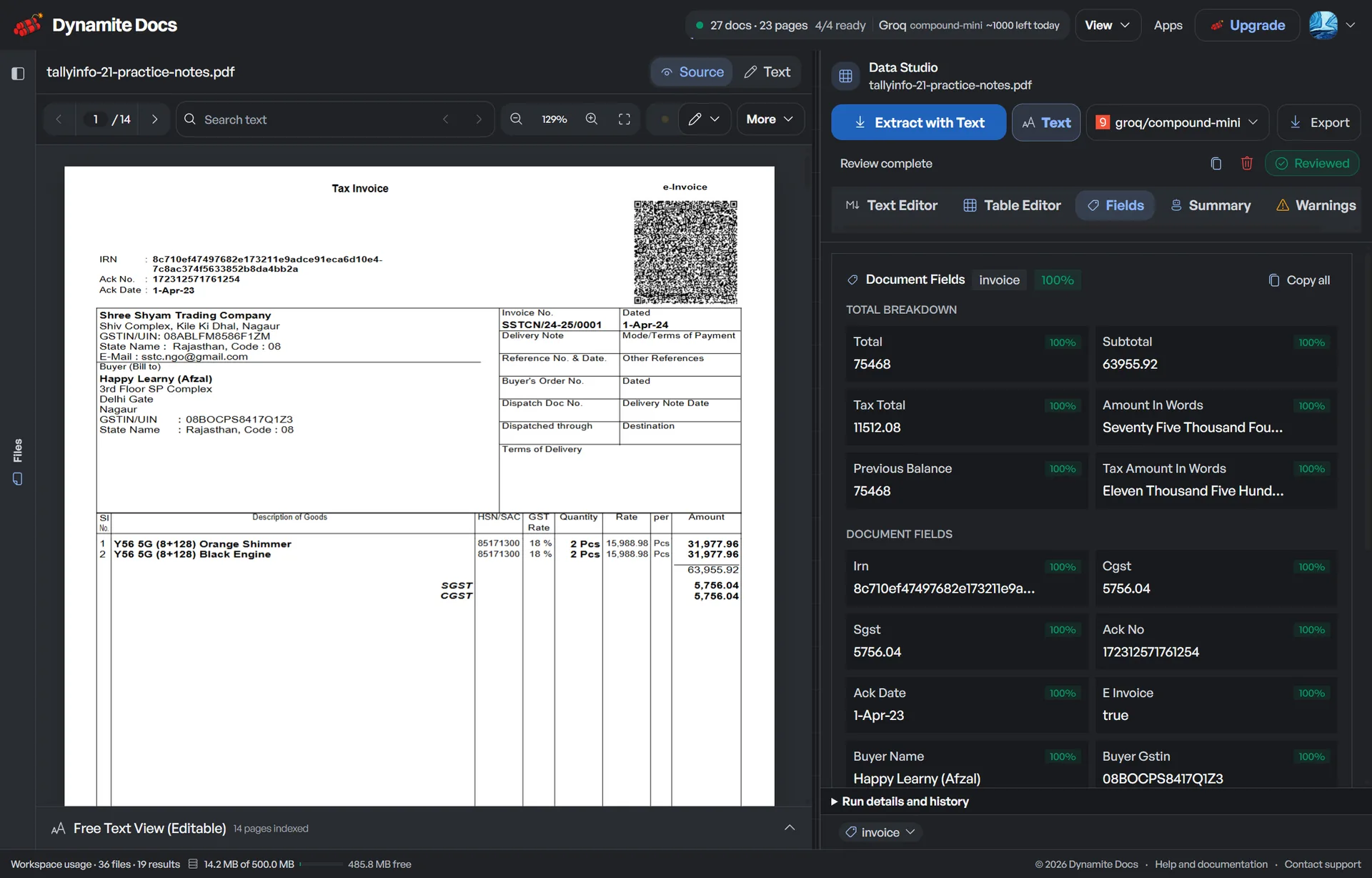
Expense receipt

इसके लिए काम करें
A document Zap
उदाहरण स्रोत
Expense receipt
- Trigger
- extraction.completed → Catch Hook
- Payload
- columns, rows, metadata, confidence
- Signature
- HMAC-SHA256 (X-Dynamite-Signature)
Trigger, map fields, send the rows.
 Zapier
IN + OUT: /api/webhooks, POST /api/v1/infer
समीक्षा की गई सामग्री .
Zapier document extraction automation can start with an incoming file or a finished result. Use a scoped API key to submit the document, then catch the signed extraction.completed webhook and map the reviewed fields into a spreadsheet, CRM or another Zapier action. Verify the signature before the Zap writes anywhere.
इस इंटीग्रेशन को ऐप में खोलें या सार्वजनिक एपीआई और वेबहुक गाइड पढ़ें ।
Stop exporting and importing the same rows by hand
- Extraction produces a table, but the table is only useful once it lands where the team works, and that usually means several different places.
- Without automation, distributing rows means exporting a file and re-importing it everywhere, by hand, every time.
- Most of the people who need this are not engineers; the tooling to wire a pipeline should not assume a developer is around.
- Automation is only safe when it can tell a genuine event from a spoofed one. An unsigned webhook is a fake-data risk.
How the Zapier connection works
01. Create a Zapier webhook trigger
In Zapier, choose the Webhooks app, create a Catch Hook trigger, and copy its public endpoint URL.
02. Register it as a Dynamite Docs webhook
Add that URL as a webhook endpoint in Dynamite Docs. Endpoints must be public HTTPS URLs, and payloads are signed with HMAC-SHA256.
03. Map the fields in the Zap
Zapier shows the received columns, rows, metadata, and confidence. Map them into the action app, a spreadsheet row or a CRM contact.
04. Send documents in via the API
For the IN direction, a Zapier Webhooks action POSTs a file to /api/v1/infer with a scoped key and consumes the structured response.
Zapier trigger and API calls
A Zap uses the following trigger, payload and API call:
- Trigger: extraction.completed → Catch Hook
- Payload: columns, rows, metadata, confidence
- Signature: HMAC-SHA256 (X-Dynamite-Signature)
- Send documents in: POST /api/v1/infer with a key
- Destinations: apps available through Zapier actions
- Retries: backoff + jitter, up to 3 attempts
एक यथार्थवादी उदाहरण
A vendor-onboarding Zap assembled in minutes:
| कदम | Module | What happens |
|---|---|---|
| Trigger | Catch Hook | Receives extraction.completed from Dynamite Docs |
| Check | Filter | Keeps only W-9 documents with confidence above 0.9 |
| Create | HubSpot contact | Writes vendor name and tax ID to the CRM |
| Store | Google Sheets row | Appends the row to the vendor register |
इस पर भरोसा करने से पहले किन बातों की पुष्टि करनी चाहिए
Verify the webhook signature before the Zap performs an action, then test filters and field mappings with a sample extraction.
Zapier turns one extraction into many side effects
A Zapier Catch Hook can receive the public webhook without a custom Zapier app. The event includes columns, rows, metadata, docType and average confidence. The Zap can then append a spreadsheet row or update a CRM record. Verify the HMAC-SHA256 signature over the raw body before any action runs.
The IN direction lets Zapier submit a document. A Zap that starts with an attachment or form submission can POST the document to /api/v1/infer with a scoped key. The response carries the structured table, which the Zap can route onward. Keys are revocable, and automated requests use the same per-document page caps and monthly processing allowance as interactive use.
Delivery reliability is built in at the webhook layer. Network errors, 429s, and 5xx retry with exponential backoff and jitter, up to three attempts, so a transient Zapier issue does not silently drop an extraction event. Zapier’s own retry behavior then takes over if a Zap step fails, which gives the pipeline two honest layers of retry instead of one.
The limits are the same as any webhook consumer. Events carry extracted data, not original file bytes, and the endpoint must be a public HTTPS URL. For teams already on Zapier, the setup is short: create the trigger, register the URL, map the fields, and turn the Zap on. For teams that prefer a DIY pipeline, the underlying webhooks and REST API are documented on their own pages.
What the Zapier connection does and does not
करता है
- Triggers Zaps with a signed extraction.completed webhook the moment an extraction finishes.
- Lets Zaps POST documents into /api/v1/infer with a scoped key and consume the structured table.
- Retries transient delivery failures so a Zapier outage does not silently drop an event.
नहीं
- Does not require Zapier-specific credentials or a private Dynamite Docs Zapier app.
- Does not send original file bytes in webhook events. The payload carries extracted data.
- Does not exempt automation from the same page caps and monthly allowance as interactive use.
Why Zapier needs no separate app
Zapier uses the public webhook and REST API. Nothing extra to install.
A no-code trigger puts extraction data in the hands of the teams that need it, including the ones that never open a terminal.
Signed delivery, retries and plan limits define what happens between the trigger and destination.
सवालों के जवाब
How do I connect Zapier to Dynamite Docs?
Create a Catch Hook trigger in Zapier, copy its public URL, and register it in Dynamite Docs. Add a verification step before the Zap trusts the HMAC-SHA256-signed payload.
Can a Zap send documents into Dynamite Docs?
Yes. A Webhooks action POSTs the file to /api/v1/infer with a scoped key and reads the structured rows from the response.
Is there a native Dynamite Docs Zapier app?
No. The connection uses the public webhook and REST API that work without Zapier, so it never depends on a private app.
Does automation count against my allowance?
Automated requests respect the same per-document page caps and monthly allowance as interactive use. Automation is not a quota workaround.
संबंधित एकीकरण लेख
एकीकरण कार्यक्षेत्र खोलें , भुगतान विवरण न दें।
के साथ शुरू
Expense receipt
इसके लिए काम करें
A document Zap
- 01Create a Zapier webhook trigger
- 02Register it as a Dynamite Docs webhook
- 03Map the fields in the Zap
- 04Send documents in via the API
Zapierके साथ शुरू
Expense receipt
इसके लिए काम करें
A document Zap
उदाहरण स्रोत
Expense receipt
- Trigger
- extraction.completed → Catch Hook
- Payload
- columns, rows, metadata, confidence
- Signature
- HMAC-SHA256 (X-Dynamite-Signature)
Trigger, map fields, send the rows.
Zapier