n8n self-hosted automation
IN + OUT: /api/webhooks, POST /api/v1/infer
Content reviewed .
Build an n8n document extraction workflow without moving the automation layer to a hosted platform. An HTTP Request node submits files with a scoped API key. A Webhook node receives the signed extraction.completed event, and your own n8n instance decides where the reviewed data goes next.
Open this integration in the app or read the public API and webhook guide.
Keep the automation graph on your infrastructure
- Some teams keep automation inside their own infrastructure for data-residency or policy reasons. A cloud workflow tool is off the table.
- A connector that only exists as a hosted app cannot be wired into a self-hosted node graph.
- Data that leaves the network just to be re-routed is a privacy and latency problem no one asked for.
- Self-hosting only helps when the connected service exposes documented webhooks and API calls that the workflow can use.
How the n8n connection works
01. Expose an n8n Webhook node
In your n8n instance, add a Webhook node (POST) and note its public URL. If the instance is not publicly reachable, expose the webhook via a tunnel or reverse proxy.
02. Register it as a Dynamite Docs webhook
Add that URL as a webhook endpoint in Dynamite Docs. The endpoint must pass the public-URL SSRF guard, and payloads arrive signed with HMAC-SHA256.
03. Build the workflow
n8n parses the payload, columns, rows, metadata, and confidence, and you wire the next nodes, a database write or a file move.
04. Call the API from n8n
For the IN direction, an HTTP Request node POSTs a file to /api/v1/infer with a scoped key and the workflow consumes the structured response.
n8n nodes and delivery behavior
The self-hosted workflow uses these inputs and checks:
- Trigger: extraction.completed → Webhook node
- Payload: columns, rows, metadata, confidence
- Signature: HMAC-SHA256 (X-Dynamite-Signature)
- Send documents in: POST /api/v1/infer with a key
- Runs: inside your n8n instance
- Retries: backoff + jitter, up to 3 attempts
A realistic example
An audit-evidence workflow in self-hosted n8n:
| Step | Node | What happens |
|---|---|---|
| Trigger | Webhook (POST) | Receives extraction.completed from Dynamite Docs |
| Filter | IF node | Keeps documents above the confidence threshold |
| Store | Postgres insert | Writes rows into the internal evidence table |
| Archive | File move | Copies the source file to the archive share |
What to validate before relying on it
Expose only a public HTTPS webhook, verify the signature in the workflow, and test error branches before the n8n flow writes to internal systems.
n8n keeps the pipeline where your data lives
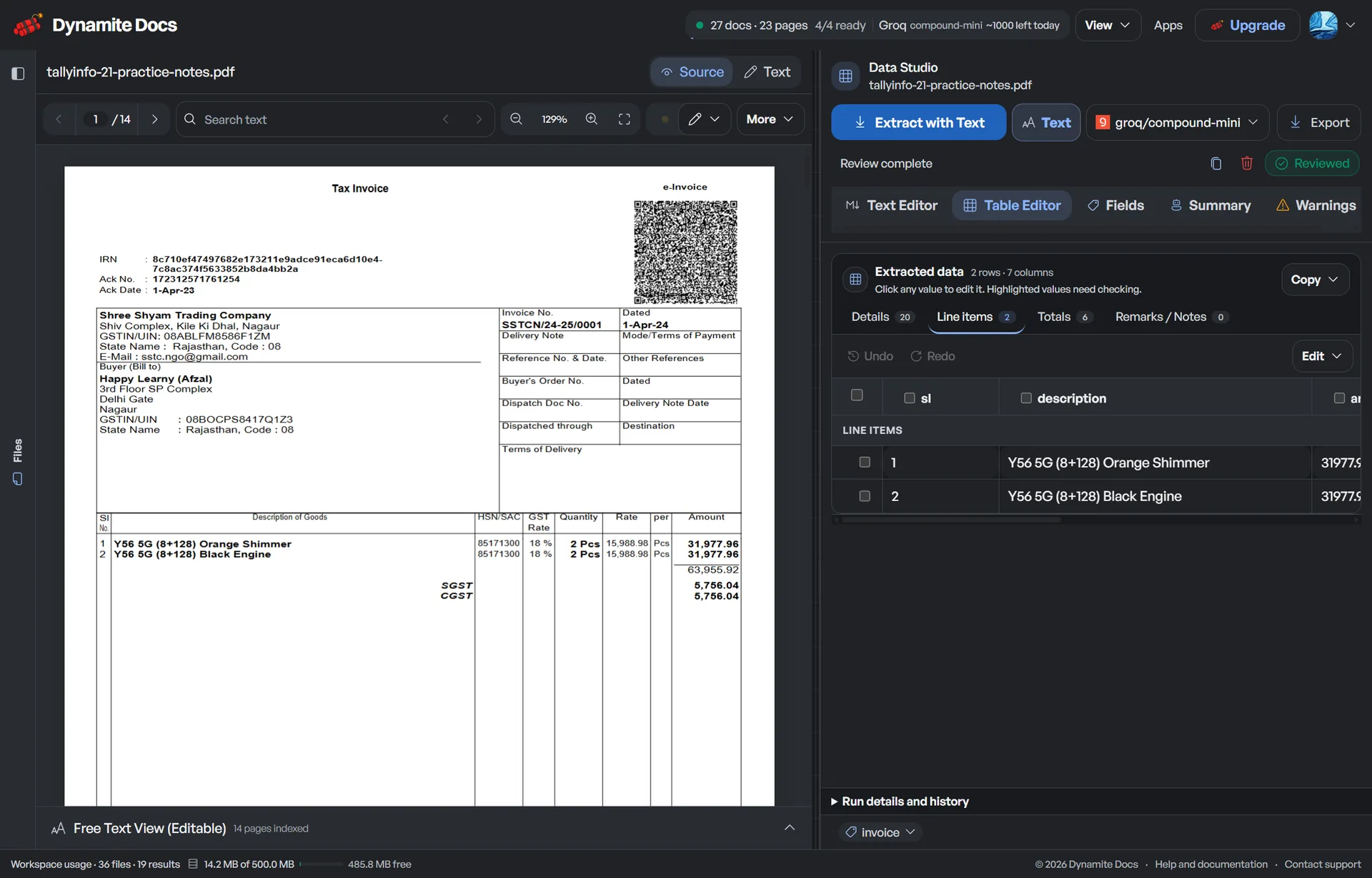
n8n runs inside your own infrastructure and uses the same webhook and REST API available to every client. An outbound webhook fires when extraction completes and sends columns, rows, metadata, docType and average confidence to an n8n Webhook node. The workflow can verify the HMAC-SHA256 signature over the raw body before any node acts.
The SSRF guard is worth spelling out for self-hosters. Webhook endpoints must be public HTTPS URLs, so an n8n instance that sits behind NAT needs its webhook exposed through a tunnel or reverse proxy to receive events. That is a deliberate safety line, not a limitation of n8n. The service will not POST to internal or loopback addresses, which keeps the webhook channel from becoming a probe into a private network. Teams that prefer not to expose a webhook at all can invert the pattern and poll the REST API from an n8n schedule instead.
The IN direction closes the loop for self-hosted pipelines. An HTTP Request node POSTs a document to /api/v1/infer with a scoped key and receives the structured table in the response. The document can arrive from anywhere in the graph. Keys are revocable, and automated requests use the same per-document page caps and monthly processing allowance as interactive use.
Webhook delivery retries network errors, 429s and 5xx responses with exponential backoff and jitter, up to three attempts. The n8n workflow can add its own error branches after receipt. No private n8n app or custom SDK is required; the Webhook and HTTP Request nodes use the documented endpoints directly.
What the n8n connection does and does not
Does
- Triggers a Webhook node in your n8n instance with a signed extraction.completed payload.
- Lets n8n POST documents into /api/v1/infer with a scoped key and consume the structured table.
- Retries transient delivery failures so a temporary n8n outage does not drop an event.
Does not
- Does not require a private n8n node or n8n-specific credentials. It uses the public webhook and REST API.
- Does not POST to internal or loopback addresses. Endpoints must be public HTTPS URLs.
- Does not exempt automation from the same page caps and monthly allowance as interactive use.
Why n8n needs no separate app
n8n uses the same public webhook and REST API as every other connector.
Self-hosted automation keeps the workflow inside your infrastructure while extraction stays a signed, verified input.
The same routes remain signed, retried, subject to plan limits and documented on their own pages.
Questions, answered
How do I connect n8n to Dynamite Docs?
Add a Webhook node in your n8n instance, expose it at a public HTTPS URL (via tunnel or reverse proxy if needed), and register it as a Dynamite Docs webhook endpoint. Verify the HMAC-SHA256 signature in the workflow.
Why does the webhook need to be a public URL?
The SSRF guard only delivers to public HTTPS URLs and never to internal or loopback addresses. Expose the n8n webhook through a tunnel or proxy, or poll the REST API on a schedule instead.
Can n8n send documents into Dynamite Docs?
Yes. An HTTP Request node POSTs the file to /api/v1/infer with a scoped key and reads the structured rows from the response.
Does self-hosting change the quota rules?
No. Automated requests respect the same per-document page caps and monthly allowance as interactive use.
Related integrations
Document workflows it feeds
Related integration articles
Open the integrations workspace, no payment details.