Purchase order processing and line item extraction
By Dynamite Docs. Published . Updated .
Stop typing invoices into spreadsheets.
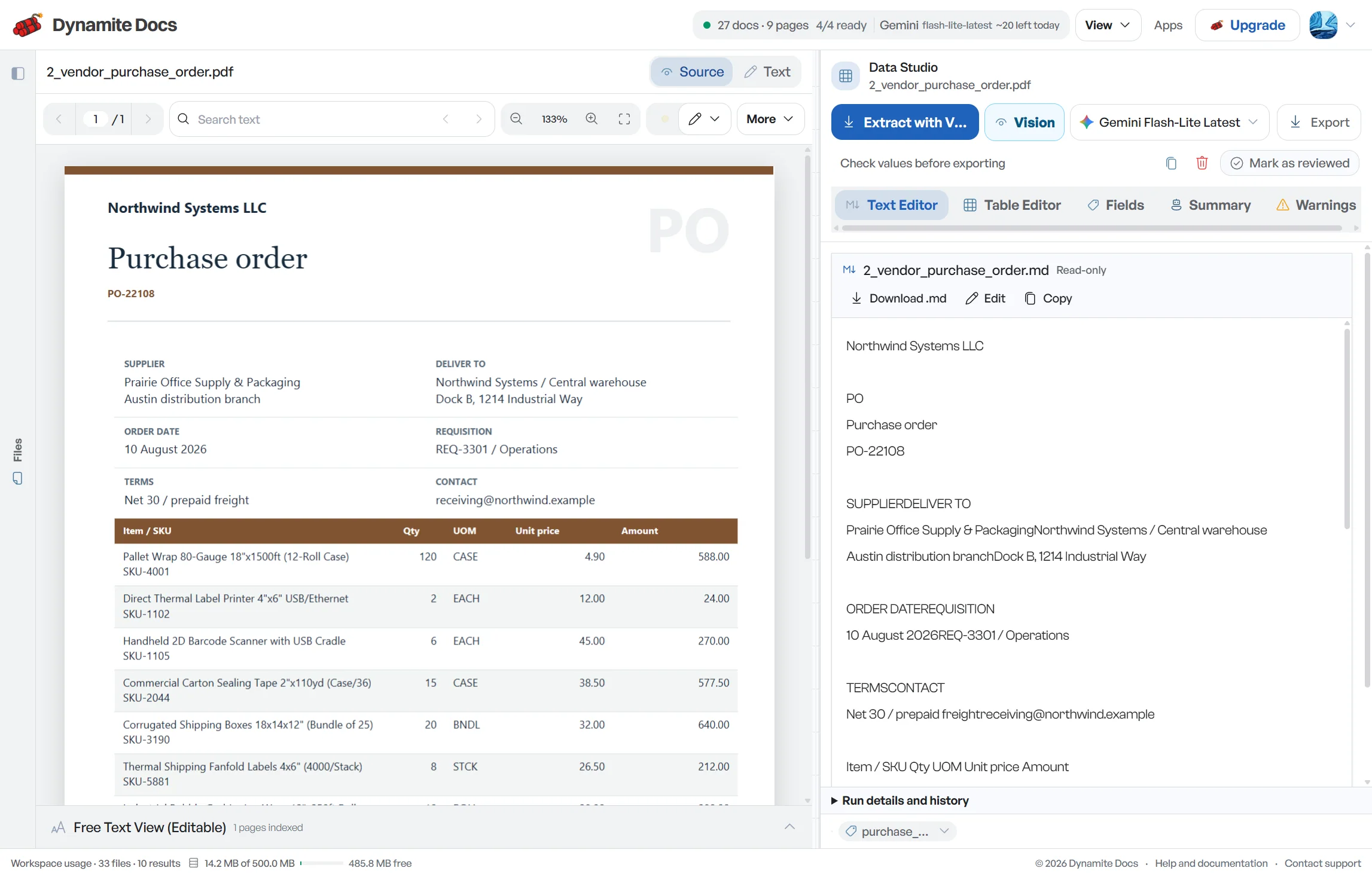
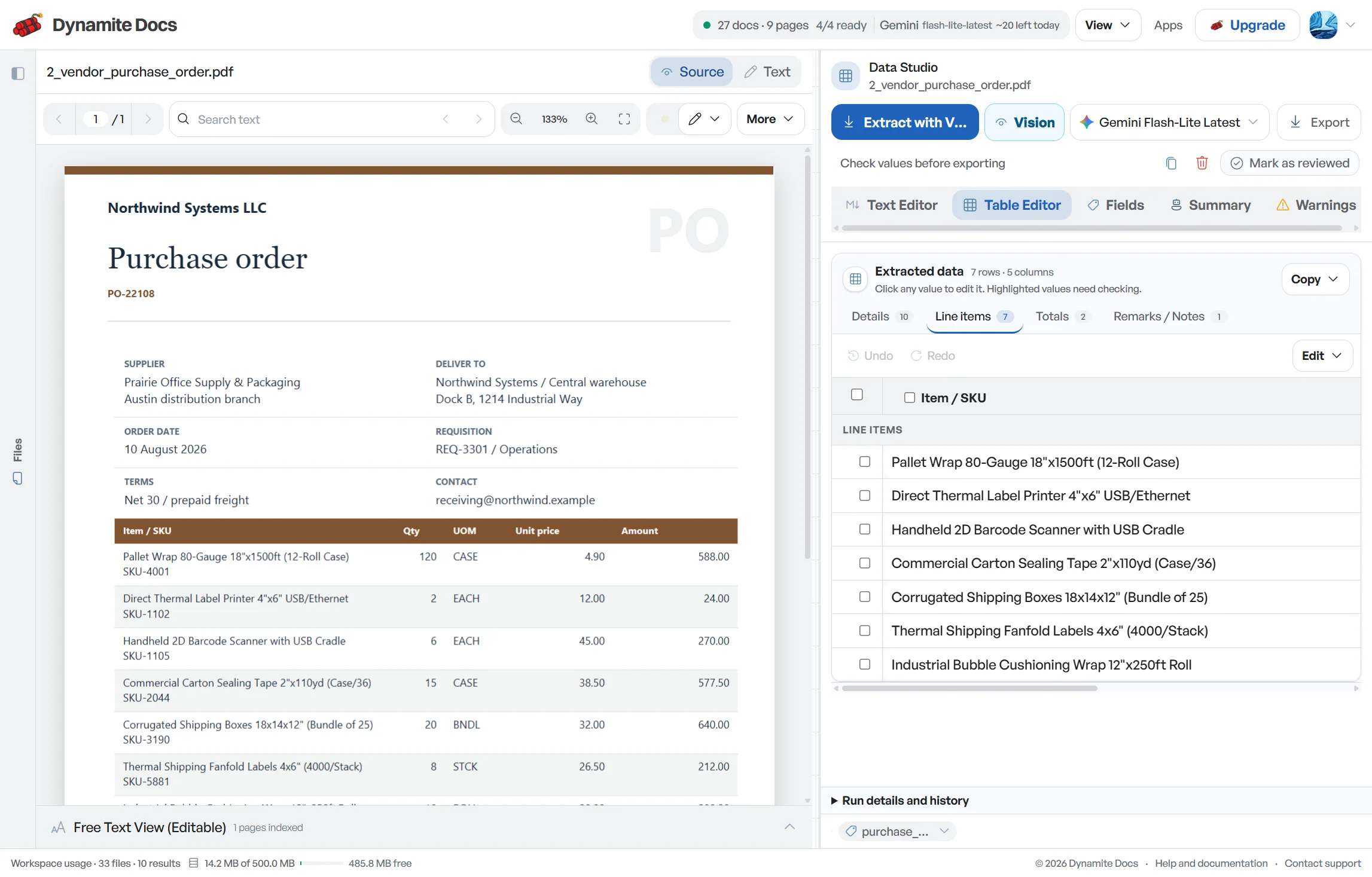
[Purchase order data extraction](/accounting/india/indian-purchase-order-extraction) turns approved order terms into rows that procurement and accounts payable can compare with later documents. Dynamite Docs proposes the PO number, supplier, ship-to location, dates, currency, quantities, units, prices and line totals from digital PDFs or scans. Review those values against the source before using them for two-way or three-way matching. Keep ordered, received and invoiced quantities separate, because a partial delivery or approved change is a business event, not a reading error.
Try an invoice or compare its storage, processing, and export limits.
Purchase orders are critical for procurement but slow to process by hand
- Purchase orders, supplier bills, and receiving slips all use different layouts, making manual comparisons time consuming.
- Line item quantities and unit pricing are easy to mistype when copying data by hand into inventory or accounting software.
- Archiving purchase orders as unsearchable PDF files makes historical price checks difficult.
- Tracking delivery dates, shipping addresses, and payment terms across dozens of active orders requires clear, organized data.
Document types this workflow handles
- Digital purchase order PDFs: orders created in purchasing software
- Scanned paper purchase orders: paper and signed order copies
- Email order attachments: POs received directly from customer or vendor emails
- Multi-line & multi-page orders: large orders with many SKU lines and delivery dates
What gets extracted from a purchase order
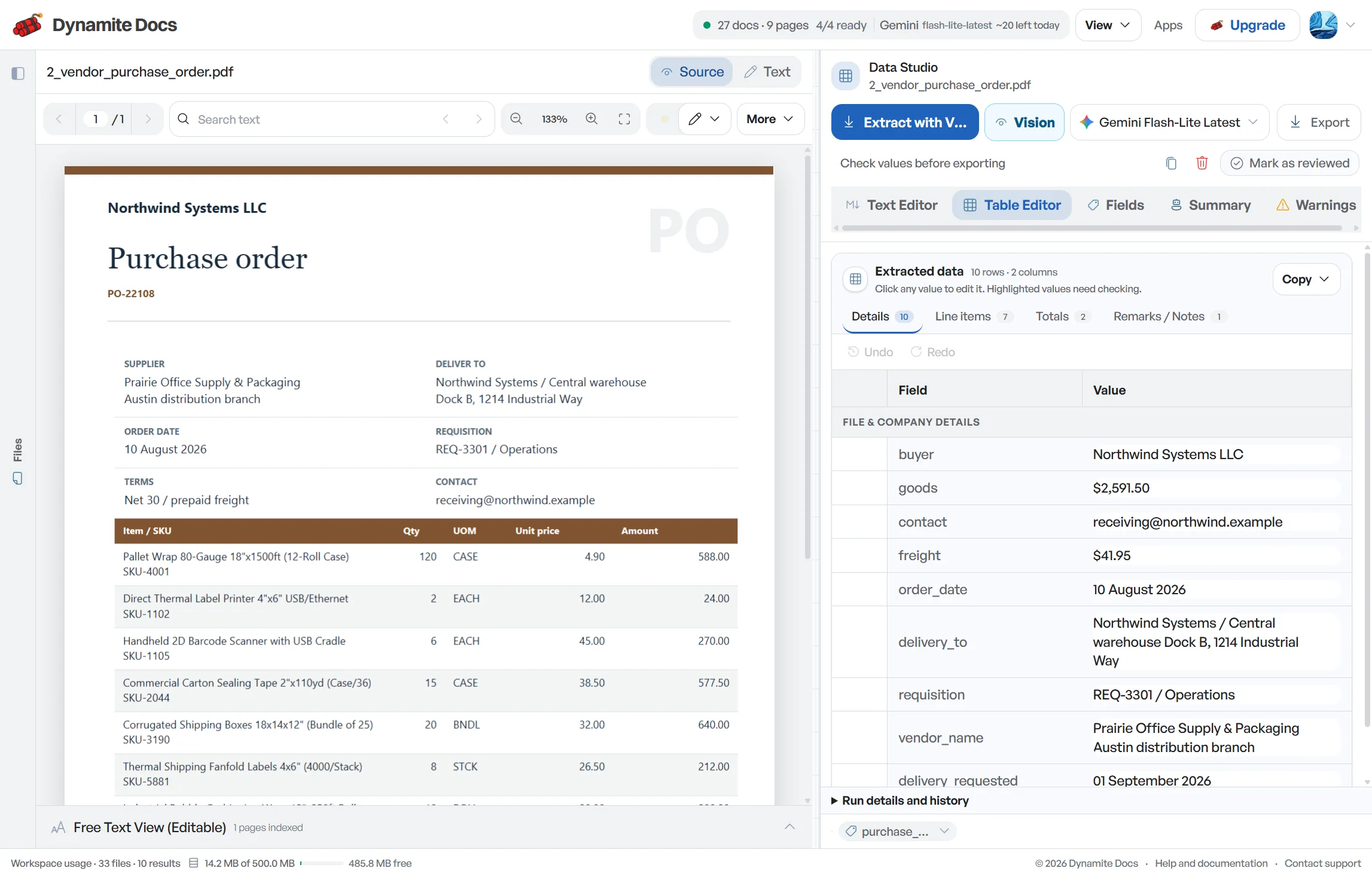
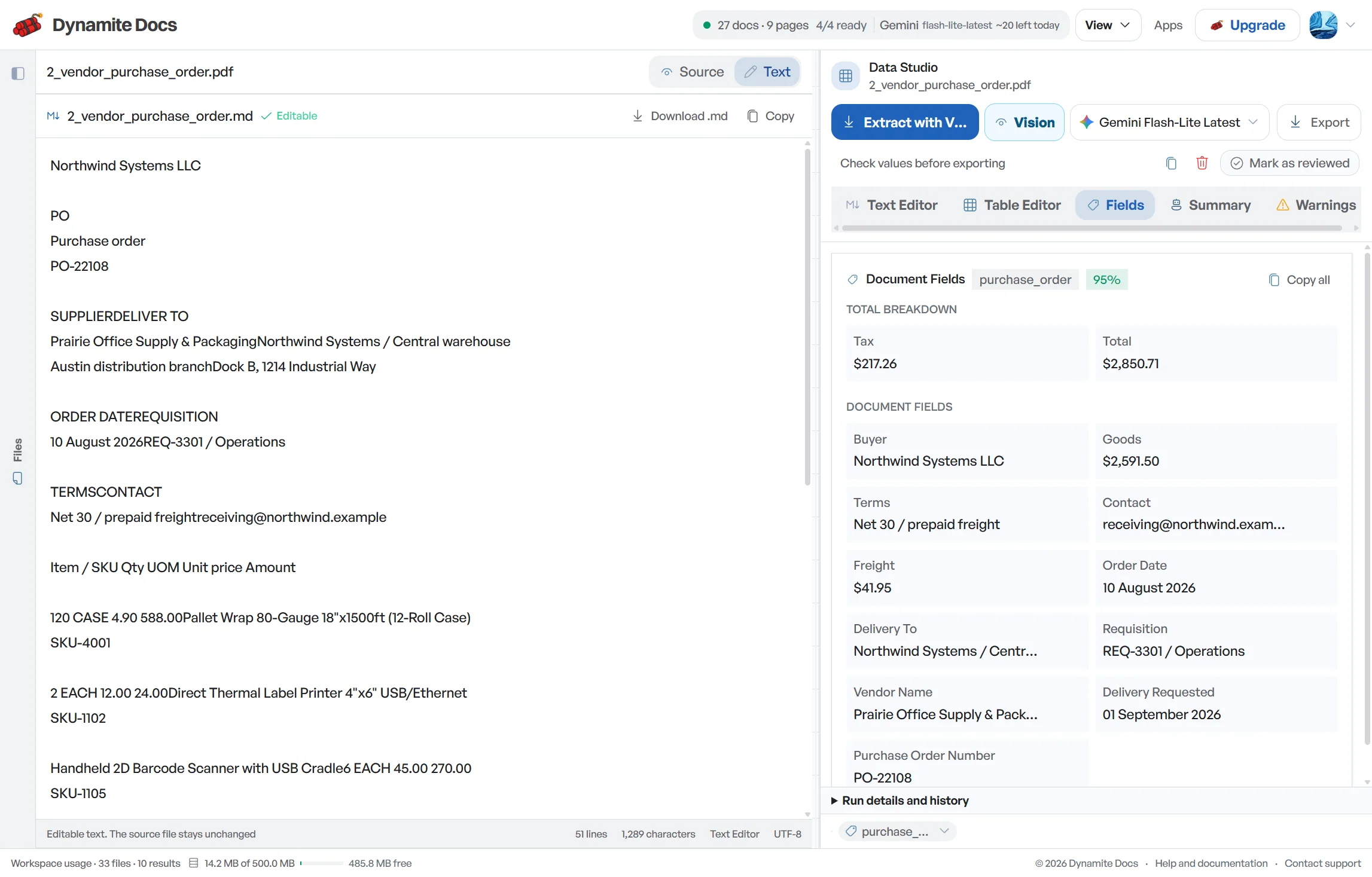
Fields are identified from each order layout. A standard extraction provides:
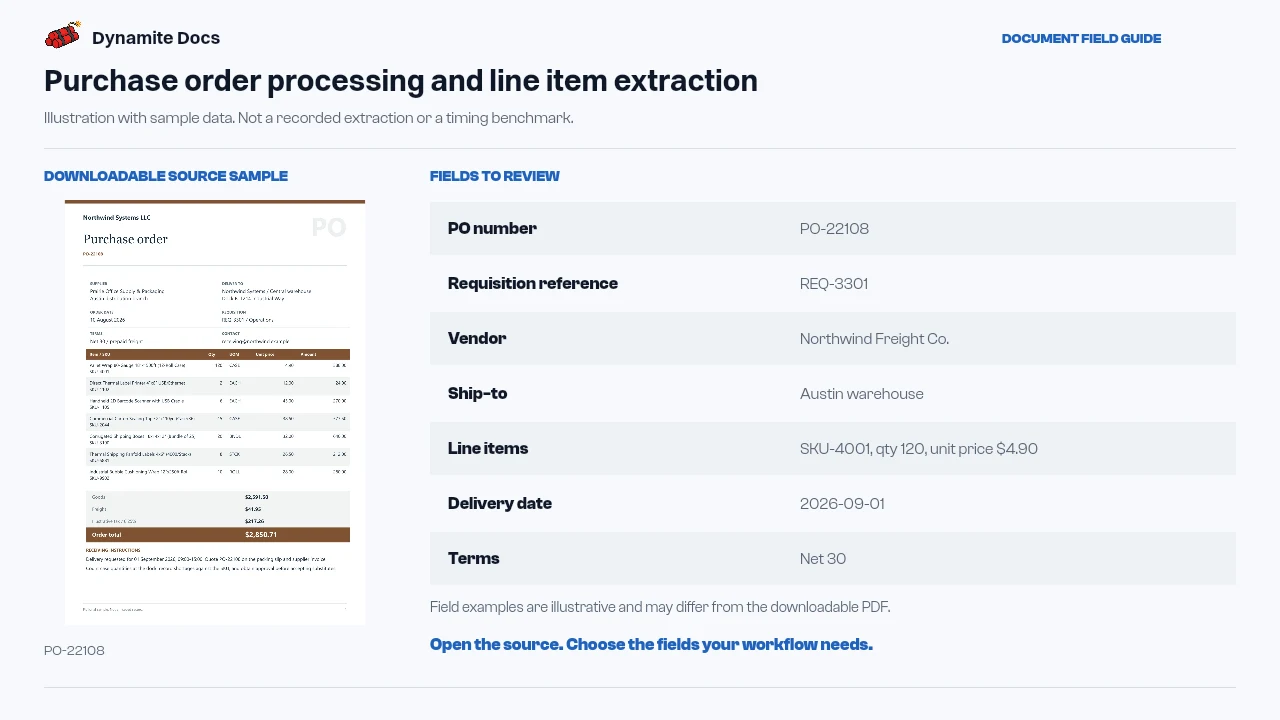
- PO number: PO-22108
- Requisition reference: REQ-3301
- Vendor: Northwind Freight Co.
- Ship-to: Austin warehouse
- Line items: SKU-4001, qty 120, unit price $4.90
- Delivery date: 2026-09-01
- Terms: Net 30
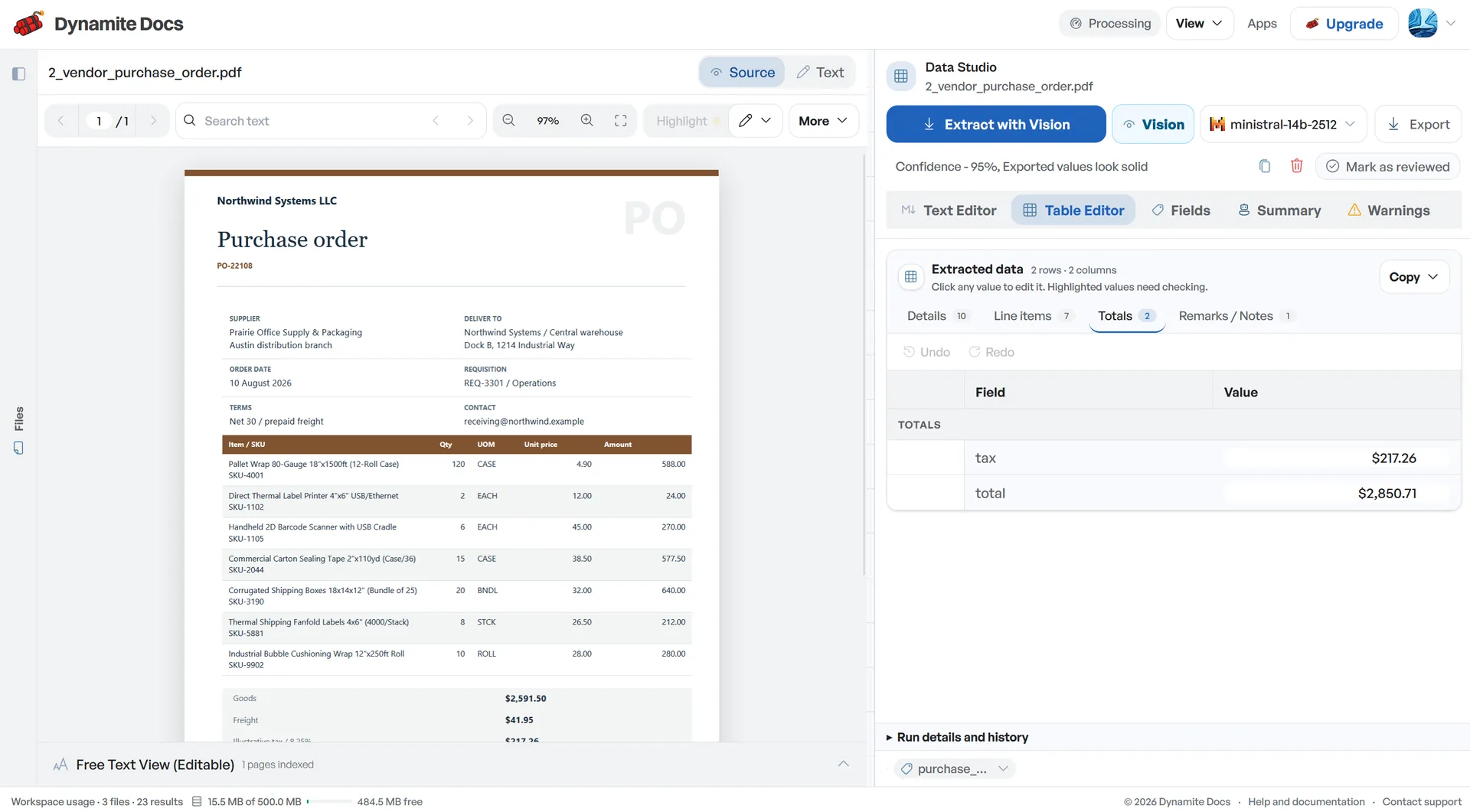
- Total: $612.00
A realistic example
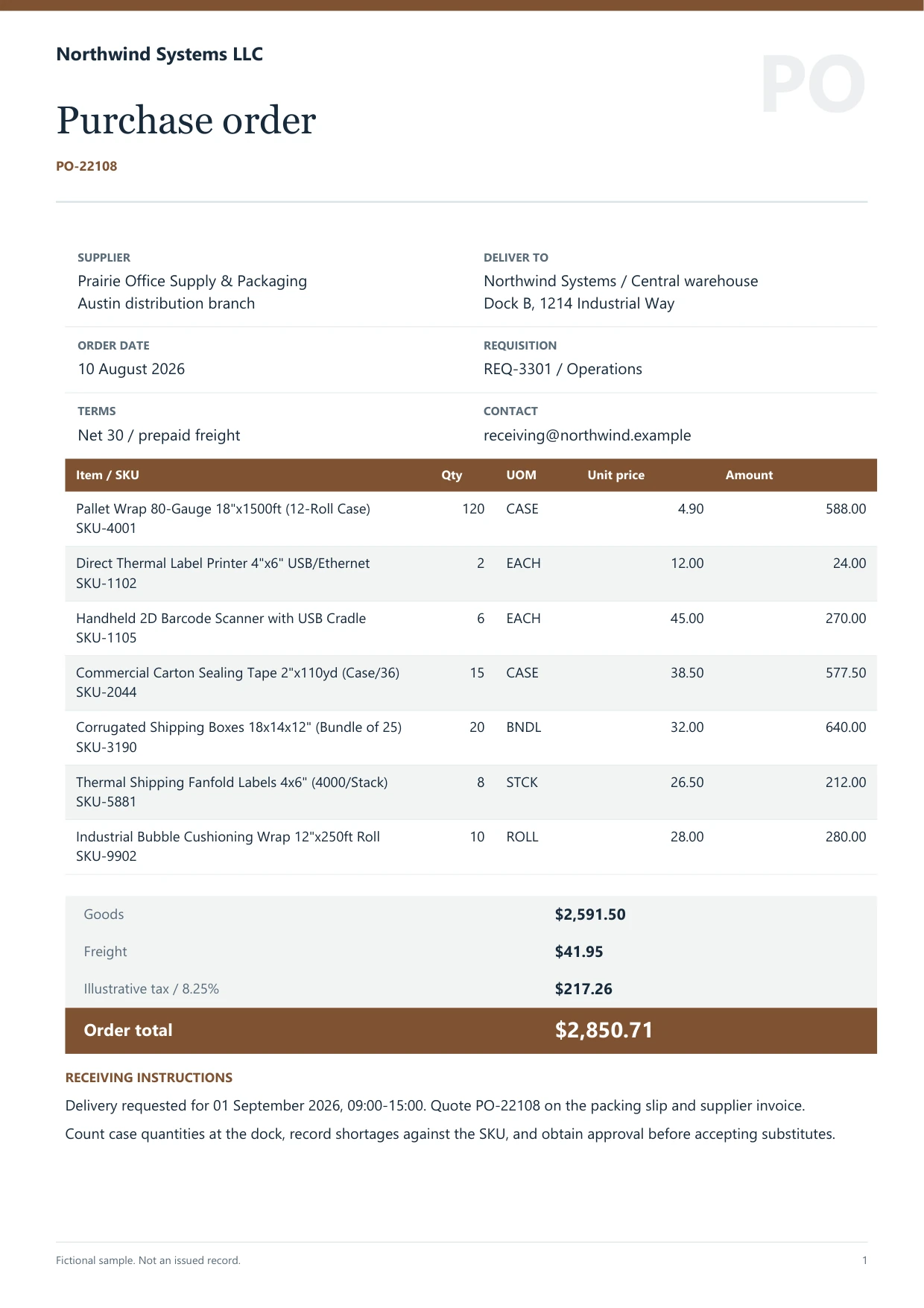
Sample data. Not a real invoice or filing record.
A purchase order extracts into organized line item rows like these, ready for matching:
| PO # | SKU | Description | Qty | Unit price | Line total |
|---|---|---|---|---|---|
| PO-22108 | SKU-4001 | Pallet wrap, 12-pack | 120 | $4.90 | $588.00 |
| PO-22108 | SKU-1102 | Label printer, 4x6 | 2 | $12.00 | $24.00 |
What to validate before export
Validation issue
Check quantities, unit prices, and line extensions against the order total.
Limitation
The output does not perform three-way matching or authorize a purchase.
Reviewed by Dynamite Docs content team. Last verified 2026-09-11.
Connecting purchase orders to invoices and receiving
Treat the approved purchase order as one source in the matching process, not as proof that goods arrived or that an invoice should be paid. Two-way matching compares the PO with the supplier invoice. Three-way matching adds the goods receipt, delivery note or service confirmation. Dynamite Docs prepares extracted inputs; the ERP or accounting process applies tolerances and approval rules.
Line identity matters as much as the PO number. Preserve the supplier SKU, buyer item code, description, unit of measure, ordered quantity, unit price, discount, tax and line total. A box, case and individual unit may refer to the same product but cannot be compared as equal quantities without a conversion rule.
Keep ordered, received and invoiced quantities in separate columns. A partial delivery is not an extraction error, and a changed invoice price is not automatically an approved amendment. Record the PO revision or change-order reference when the source provides one. Otherwise, the matching table can flag a difference but cannot explain who authorized it.
Header fields also control the comparison. Confirm the buying entity, supplier, currency, ship-to address, promised date, freight terms and payment terms. If one PO covers several locations or delivery dates, preserve that context at line level rather than repeating a single header value across every row.
Watch for page furniture on long orders. Repeated headers, carried-forward subtotals and terms pages can look like data rows. Compare the extracted line count with the source and recalculate extensions where quantity and unit price are both available. Then check whether discounts, freight and tax explain the gap between line totals and the order total.
Start with one active supplier and a completed document set: approved PO, receipt evidence and invoice. Agree on the keys used to join them, such as PO number plus line number or SKU. Once the exported columns support that comparison, add other layouts. Saved corrections can help recurring formats, but matching logic still belongs in the destination system.
Efficient, accurate procurement data extraction
Purchase orders contain dense line tables, so choose a provider and plan that fit the document type and volume. Any signed-in plan can use a supported provider key. Pro and Ultra BYOK runs do not spend Dynamite Docs PE, though provider and file-size limits still apply.
Digital PDFs may expose a text layer; scanned documents need a vision-capable model. Structured extraction still has to recover headers, rows and document-level fields in both cases.
Saved correction patterns can help recurring layouts. Keep the source, review state and export together so a later price or quantity question can be traced back to the approved PO.
Questions, answered
Can it help match purchase orders to supplier invoices?
Yes. Dynamite Docs extracts PO numbers, line item SKUs, quantities, and prices from both purchase orders and vendor bills, giving your accounting software clean data for matching.
Can it handle multi-page purchase orders with dozens of items?
Yes. Multi-page purchase orders are processed line by line up to your plan per-document page limit (from 5 pages on Free up to 1,000 pages on Ultra).
How does it handle scanned paper purchase orders?
Scanned orders and paper copies are read using optical character recognition (OCR) with the vision model you select.
What export options are available for purchase order data?
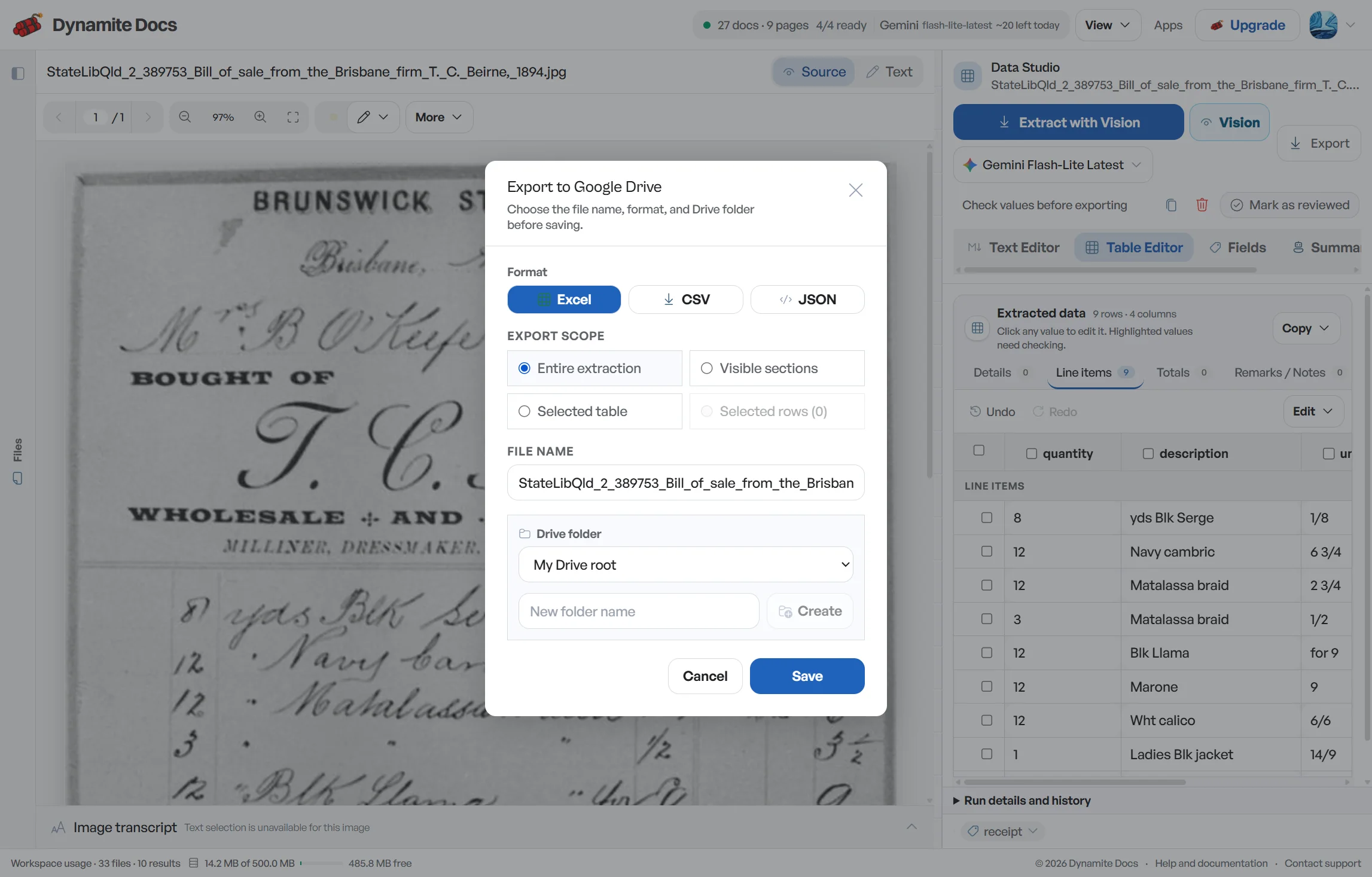
You can export your data to Excel, CSV, JSON, Word, or Google Sheets, or integrate directly with your systems using our REST API and webhooks.
Related document workflows
Related extraction articles
Open the document extraction workspace, no credit card required.