Free document tool
Free tool to parse structured JSON fields from photographed documents
Read fields and tables from an image, then export reviewed JSON.
Upload a document photo, screenshot or scan. AI image-to-JSON extraction reads labels, values and repeating rows, then opens the structured result beside the source. Check field names, nulls, identifiers and types before your application consumes the download.
Content reviewed .
JSON, CSV and Excel downloads are included on Free after signup, within Free plan limits. See Free limits.
Anonymous originals stay in browser storage, not cloud file storage. Extraction may send document content to the selected AI provider.
Upload a document image. JPG, PNG, WebP, GIF, TIFF or AVIF image files are supported up to 50 MB.
28-day Free trial · 25 page-equivalents · 5 hosted pages/document
What is included in the image JSON export?
Dynamite Docs uses AI OCR to extract labelled fields and table rows from a document photo, scan, or screenshot. Review the values beside the image, then export JSON for your mapper.
Valid JSON can still contain an OCR mistake. Keep identifiers as strings and validate required fields, dates, amounts, arrays, and null handling in your application.
How do you convert an image of a document into structured JSON data?
Use Image to JSON when developers need structured JSON fields and row arrays from a document photo, scan, or screenshot. Capture high-resolution images with uncropped margins so field labels remain clearly associated with their corresponding values.
During review, cross-check extracted key-value pairs and table rows against the source image. Verify that alphanumeric identifiers retain leading zeros as strings, that dates follow standard formats, that decimal amounts avoid floating-point distortion, and that missing values are mapped to consistent null representations.
Use Image to CSV for flat tabular imports, or Image to Excel for spreadsheet analysis. When the image is a commercial invoice, use Invoice to JSON for specialized vendor, tax, and line-item mapping. For recurring programmatic image ingestion, connect via our REST API with saved schemas, webhook callbacks, and retry handling.
Compare monthly processing allowances and plan limits or read the step-by-step extraction and review guide.
Check document extraction results with Dynamite Docs with these sample files
Hariom Stationers tax invoice
Open image Download image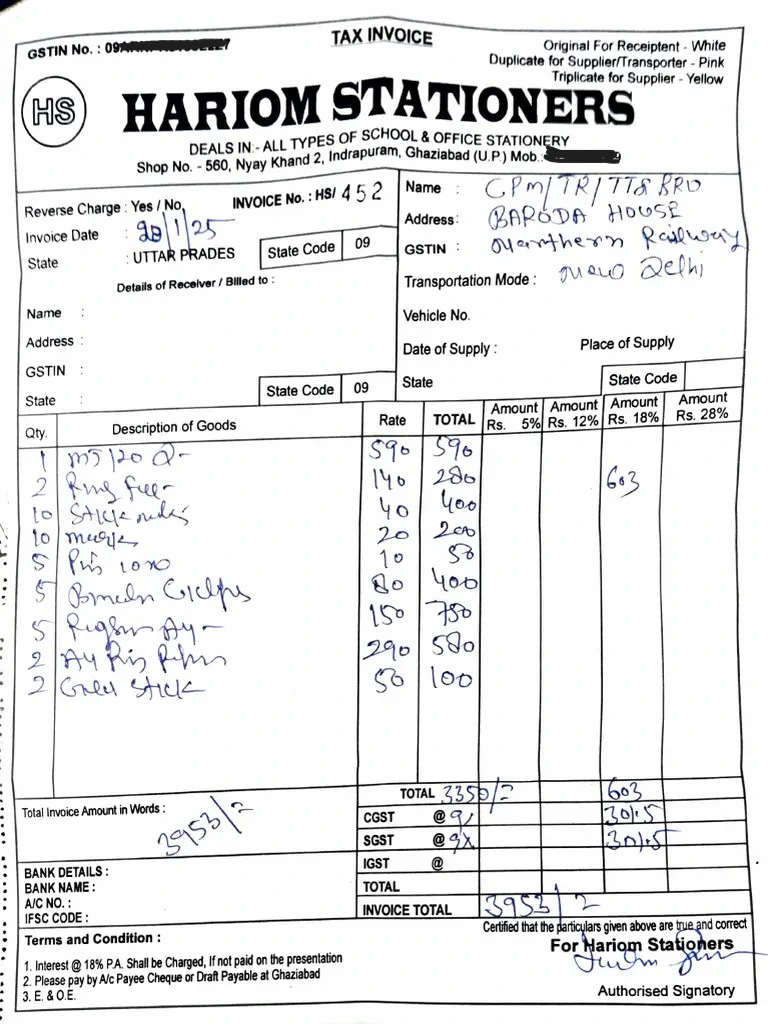
The output stays beside the evidence
Dynamite Docs keeps the source and structured result in one review workspace. Infer document fields and repeating rows, correct values against the page, inspect warnings and export the accepted result.
This is more than a plain OCR transcript. The result separates fields, line items, totals and notes so a person can check the structure before sending data to Excel, CSV, JSON, Google Sheets, Google Drive, a webhook or the API.
Connect an AI provider and get a key
Choose a hosted model or connect your own provider key for the extraction.
Provider keys are encrypted before storage. Compare processing options or follow the setup guide.
What the structured image JSON contains
- Labels outside a table can become reviewed document fields instead of being mixed into each repeating row.
- Detected table records retain column definitions and row arrays so an application can map them into its own objects.
- The download includes structured values and metadata, not the original image bytes or a Base64 copy of the picture.
- The reviewed result separates source extraction from application design. Your mapper decides final property names, nesting, required values and whether an absent field becomes null, empty text or an omitted key.
- Identifiers should remain strings, money needs decimal-safe handling and dates need a confirmed source convention before normalization. Preserve the visible source value beside any converted representation.
Map image fields and rows into JSON
The download contains columns, rows, document fields, and extraction metadata. It does not store the picture as Base64, and it is not a fixed schema for every document type.
- document_type: service_record
- fields: Named values outside the table
- columns: Definitions for repeating row values
- rows[]: Records recovered from the image table
- identifiers: Strings that preserve leading zeros
- metadata: Extraction and source context
Extract first, then decide what to keep
- Upload and extract one document image without creating an account.
- Review low-confidence values beside the source document.
- JSON, CSV and Excel downloads are included on Free after signup, within Free plan limits.
- Starter and above add stored files, batch jobs and connected exports. Email intake requires Pro or Scale. File and processing limits depend on your plan.
Compare batch-processing plans or read how extraction and review work.
Validate the values before the JSON contract
Check labels, row boundaries, data types, nulls, dates, and long identifiers against the source image. Then map the reviewed product export into your application schema and validate that schema at the integration boundary.
Cases that need manual review
- A cropped label can leave a visible value without enough context to choose a reliable JSON property name.
- Long numeric identifiers can lose leading zeros if downstream code treats them as numbers instead of strings.
- Two unrelated tables in one screenshot need separate mappings and should not be forced into one rows array.
- Blur or compression can produce a plausible wrong character that still passes a JSON Schema type check.
- Inferred field names can change across similar images, breaking consumers that use them as a production contract without a mapping layer.
- Prototype an API payload from a document screenshot
- Extract form fields and a repeating table from one image
- Prepare reviewed image data for an application mapper
Read the image OCR guide for photo, screenshot, scan, and table quality before choosing an output format.
Choose the page for the job
Use Image to JSON when developers need structured JSON fields and row arrays from a document photo, scan, or screenshot. Capture high-resolution images with uncropped margins so field labels remain clearly associated with their corresponding values.
During review, cross-check extracted key-value pairs and table rows against the source image. Verify that alphanumeric identifiers retain leading zeros as strings, that dates follow standard formats, that decimal amounts avoid floating-point distortion, and that missing values are mapped to consistent null representations.
Use Image to CSV for flat tabular imports, or Image to Excel for spreadsheet analysis. When the image is a commercial invoice, use Invoice to JSON for specialized vendor, tax, and line-item mapping. For recurring programmatic image ingestion, connect via our REST API with saved schemas, webhook callbacks, and retry handling.
Questions about Free tool to parse structured JSON fields from photographed documents
The 28-day Free trial includes 25 page-equivalents per month shared by hosted and own-key processing, 5 hosted pages per document, and 5 documents per day. Anonymous trials have separate daily limits.
Does Image to JSON encode the picture as Base64?
No. This tool extracts visible document data into fields and rows. It does not serialize the original image bytes into a JSON string.
Can I choose my own JSON property names?
Review and rename inferred columns in the workspace. For a repeatable production schema, save a preset and validate the exported values in your application.
When should I use the document extraction API?
Use the free page to inspect one file and a sample output. Use the API when software needs authentication, repeatable schemas, retries, and automated delivery.
How should I handle OCR confidence in an application?
Use it to route fields for review, not as proof that a value is correct. Define which identifiers, dates and amounts always need source comparison, and send missing or unexpected fields to an exception path instead of accepting the payload silently.
Why should identifiers remain strings?
Work-order numbers, account references, postal codes and similar values may contain leading zeroes, punctuation or letters. Numeric conversion can alter them without producing an error. Keep the reviewed representation as text and validate its business format separately.
More free document tools
- Free AI tool to convert photos, scans, and screenshots to Excel: Turn a table photo or screenshot into real Excel cells, not an image inside a sheet.
- Free reader to extract tabular images and scans into CSV rows: Convert a table image to CSV, with every row open for review first.
- Free parser to extract structured invoice JSON for APIs and apps: Turn one invoice into JSON you can inspect before your code sees it.