CGST, SGST, and IGST tax split extraction
By Dynamite Docs. Published . Updated .
Turn GST invoices into clean, reviewed data for Excel and Tally.
GST invoices can show CGST and SGST or UTGST, IGST, cess and several tax rates across line and summary tables. Dynamite Docs extracts the printed components into separate columns and calculates review checks between taxable value, tax amounts and the [invoice](/accounting/india/gst-invoice-to-excel) total. These checks can expose a missing or misread number. They do not determine the correct place of supply, confirm the legal tax treatment or prove that the supplier calculated GST correctly. Your tax reviewer remains responsible for those decisions.
Try a GST invoice or compare its storage, processing, and export limits.
Tax calculation and breakdown errors cause bookkeeping mismatches
- Intra-state sales require equal CGST and SGST splits, while inter-state transactions apply IGST. Recording the wrong tax type leads to ledger discrepancies.
- Suppliers format tax tables differently: some use 3-column layouts, while others stack tax lines beneath each product.
- Multi-rate invoices containing 5%, 12%, 18%, and 28% items create complex mathematical splits that simple tools flatten into an unstructured sum.
- Small rounding differences or misread digits can cause invoice totals not to tie out to taxable amounts.
Document types this workflow handles
- Intra-state tax invoices: equal CGST and SGST/UTGST splits
- Inter-state tax invoices: integrated IGST rate and amount
- Multi-rate purchase bills: mixed 5%, 12%, 18%, and 28% tax rates
- Invoices with Compensation Cess: cess on motor vehicles and luxury goods
What gets extracted from the tax block
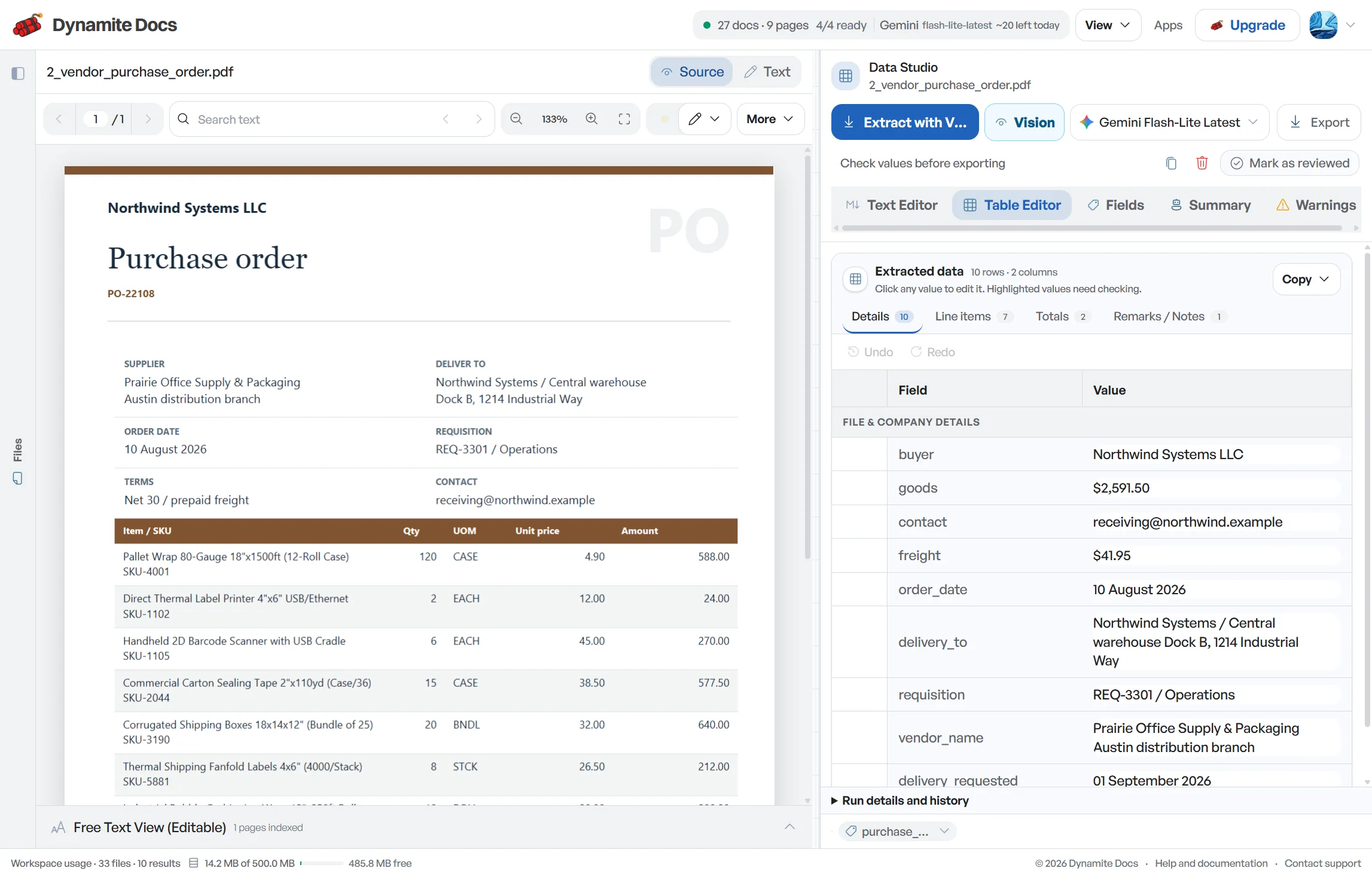
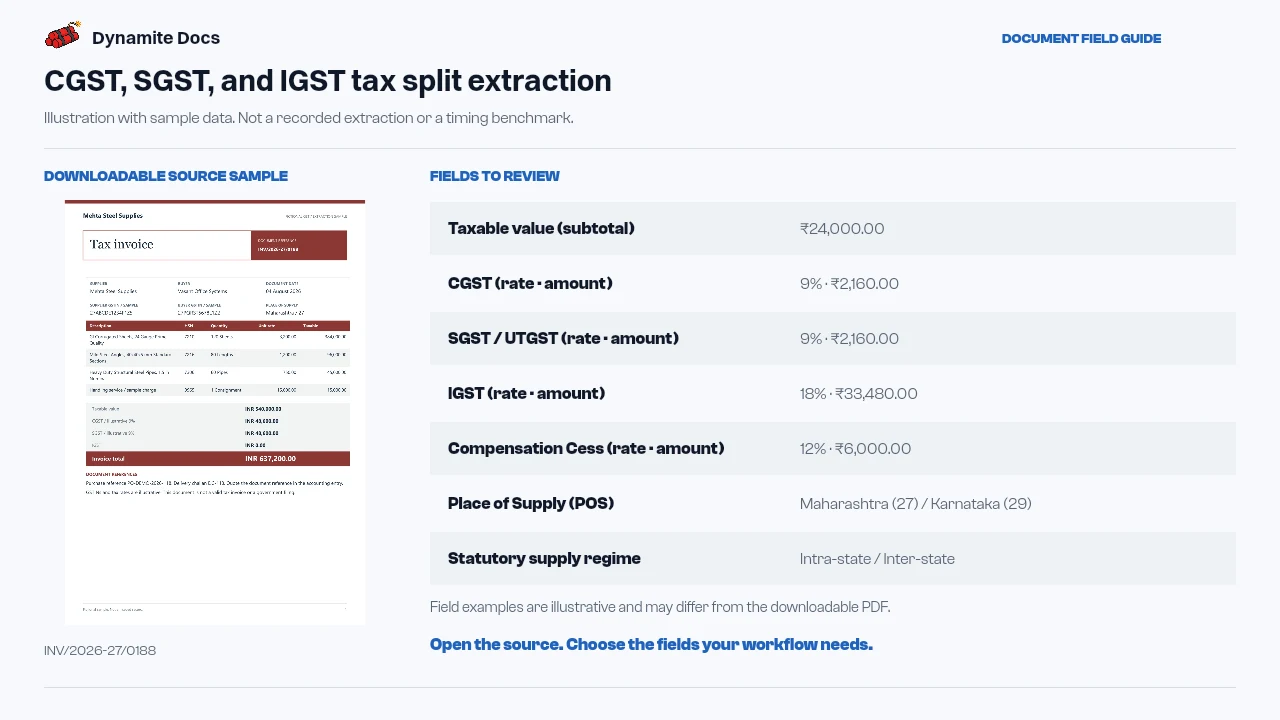
The tax split is captured as distinct, confidence-scored rate and amount fields tied to the place of supply:
- Taxable value (subtotal): ₹24,000.00
- CGST (rate · amount): 9% · ₹2,160.00
- SGST / UTGST (rate · amount): 9% · ₹2,160.00
- IGST (rate · amount): 18% · ₹33,480.00
- Compensation Cess (rate · amount): 12% · ₹6,000.00
- Place of Supply (POS): Maharashtra (27) / Karnataka (29)
- Statutory supply regime: Intra-state / Inter-state
- Mathematical tie-out status: Balanced (Taxable + Tax = Total)
A realistic example
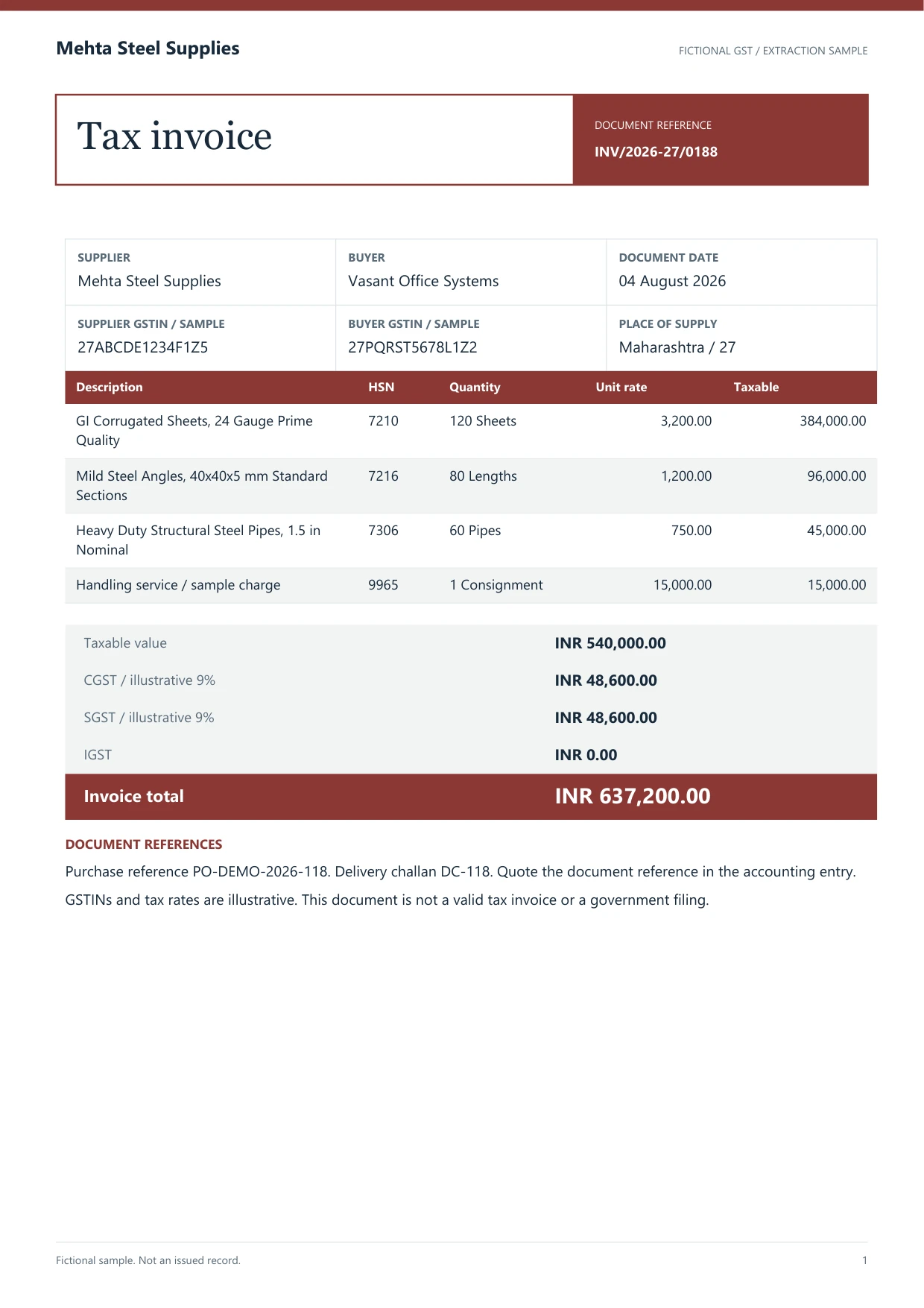
Sample data. Not a real invoice or filing record.
A mixed batch of intra-state and inter-state invoices extracts into reconciled rate-and-tax columns:
| Invoice # | Place of Supply | Taxable Value | CGST (9%) | SGST (9%) | IGST (18%) | Cess | Grand Total |
|---|---|---|---|---|---|---|---|
| INV/26-27/0144 | 27 - Maharashtra (Intra) | ₹24,000.00 | ₹2,160.00 | ₹2,160.00 | Not applicable | Not applicable | ₹28,320.00 |
| SI-2026-0881 | 29 - Karnataka (Inter) | ₹1,86,000.00 | Not applicable | Not applicable | ₹33,480.00 | Not applicable | ₹2,19,480.00 |
| EXP/2026/092 | 07 - Delhi (Inter) | ₹50,000.00 | Not applicable | Not applicable | ₹14,000.00 (28%) | ₹6,000.00 | ₹70,000.00 |
What to validate before export
Validation issue
Reconcile the tax split to taxable value, rate, and invoice total.
Limitation
The extractor does not decide which tax regime should apply.
Reviewed by Dynamite Docs content team. Last verified 2026-09-11.
Understanding GST tax splits and calculation checks
The printed tax split gives the extraction workflow its first clue, but it should not be the only basis for classification. Place-of-supply and supplier-location rules can be fact-specific. Capture the supplier GSTIN, buyer GSTIN, place-of-supply text, document type and printed tax labels together so the reviewer sees the context behind each amount.
Multi-rate invoices need both line-level and summary-level review. Calculate the expected tax for each taxable base and compare the sum with the printed tax summary. Keep discounts, freight, round-off and cess separate. If the difference is within a configured rounding tolerance, record it as such; do not silently force the values to balance.
A useful exception schedule distinguishes extraction problems from source-document questions. “Unreadable amount” means the image needs review. “Arithmetic variance” means the printed components do not add up. “Unexpected tax type” means the displayed split conflicts with the reviewer’s expectations. Those exceptions require different owners and should not be collapsed into one generic error.
Credit and debit notes also need sign handling. Preserve the document type and source amounts, then apply the reporting sign in a separate reviewed field. This prevents an adjustment from looking like an ordinary invoice simply because all values were printed as positive numbers.
Mathematical checks can highlight rounding differences, dropped digits and rows assigned to the wrong column. They cannot establish whether the rate, classification or GST treatment is legally correct. Retain the source document and reviewer decision with the exported schedule.
Tax breakdown with source review and data ownership
Every signed-in tier can connect a supported provider key. Free and Hobby own-key pages use monthly PE; Pro and Ultra own-key runs do not consume PE.
Digital PDFs may expose embedded text, while paper scans need visual extraction. Calculation checks help find exceptions, but the source remains the authority.
Reviewed tax rows can be exported to Excel, CSV or JSON, or pushed to Google Sheets. Map and test the file before using it in Tally, BUSY, Zoho Books or another accounting system.
Questions, answered
How does the system distinguish intra-state from inter-state invoices?
The workflow extracts supplier location, place-of-supply text and printed tax columns so a reviewer can assess the treatment. It does not make a final place-of-supply or intra-state versus inter-state determination.
How does it handle multi-rate invoices with different tax percentages?
Taxes are extracted at both the line-item level and summary level. Each product retains its specific rate and taxable amount, while the summary table confirms the total tax breakdown.
What happens if CGST and SGST amounts do not match?
The workflow can flag a difference between the displayed CGST and SGST values, such as ₹2,160 versus ₹2,168. The reviewer should check whether it is an extraction mistake, source arithmetic issue, rounding treatment or a transaction that needs specialist review.
Does extraction capture GST Compensation Cess?
Yes. When an invoice includes Compensation Cess (such as on passenger vehicles or luxury goods), cess is extracted into its own column rather than merged with IGST.
Related document workflows
Related extraction articles
Open the document extraction workspace, no credit card required.